What should Bryan property owners know about after concrete leveling care?
- After leveling, follow the project-specific instructions you receive, keep drains and discharge paths clear, and watch the repaired area during ordinary use and rainfall.
- Maintenance should focus on water management, joint condition, and early documentation rather than aggressive cleaning or unapproved fillers.
- Evaluate the concrete, support, drainage, access, and intended use together.
Answer: After leveling, follow the project-specific instructions you receive, keep drains and discharge paths clear, and watch the repaired area during ordinary use and rainfall.
Which primary sources support this guidance?
The following primary or standards-based resources explain the underlying safety, soil, material, or installation principles. Local codes and a site-specific assessment control the final scope.
- FHWA concrete repair guidance
- 2010 ADA Standards for Accessible Design
- EPA National Stormwater Calculator
Related local service: Commercial Concrete Repair.
What are the main takeaways about after concrete leveling care in Bryan?
| Observation | What to record | Practical response |
|---|---|---|
| Core finding | After leveling, follow the project-specific instructions you receive, keep drains and discharge paths clear, and watch the repaired area during ordinary use and rainfall. | Photograph and compare over time; request an assessment if the condition is active or creates a safety risk. |
| Decision scope | Maintenance should focus on water management, joint condition, and early documentation rather than aggressive cleaning or unapproved fillers. | Photograph and compare over time; request an assessment if the condition is active or creates a safety risk. |
| Safety condition | A site-specific evaluation is the right next step when the condition is changing, affects drainage, or interferes with normal use. | Photograph and compare over time; request an assessment if the condition is active or creates a safety risk. |
Why this concrete issue matters in Bryan
After leveling, follow the project-specific instructions you receive, keep drains and discharge paths clear, and watch the repaired area during ordinary use and rainfall. For Bryan homeowners and property managers, the practical concern is how the surface performs: whether people can cross it comfortably, water can drain, vehicles or equipment can use it, and adjoining construction remains undisturbed.
Local exterior concrete is part of a larger site. Aftercare varies by material, joint treatment, weather, and the repaired surface, so generic internet timelines should not replace the contractor’s written guidance. That does not mean one factor caused a particular problem. It means an assessment should include the slab, adjacent soil, runoff, drains, joints, landscaping, and the way the surface is used.
A useful evaluation begins with the entire surface and its surroundings. Looking only at the most visible crack can miss a low corner, a drainage route, or a connected panel that explains the pattern.
What to look for before requesting an evaluation
Make observations from a safe position and avoid lifting, grinding, drilling, or filling the area before the condition is understood. A short record of what changed and when can be more useful than trying several temporary fixes.
- Save the scope and photos.
- Confirm access timing.
- Observe drainage.
- Report unexpected movement promptly.
Also compare adjoining elevations. A line in the surface with level edges may call for a different response than a line with one side noticeably higher. Crumbling material, exposed reinforcement, movement at a building, or a sudden major change deserves specialized attention beyond a routine maintenance article.
How a professional evaluates the condition
A concrete repair evaluation typically starts with the affected panel and then works outward. The evaluator can review elevations, crack and joint patterns, slab edges, drainage, access, surrounding construction, and evidence of voids or lost support. The objective is to determine what moved, what remains stable, and what outcome is realistic.
Maintenance should focus on water management, joint condition, and early documentation rather than aggressive cleaning or unapproved fillers. A sound panel that has settled may present different options from concrete that is badly fragmented, too thin, or no longer capable of serving its intended use. Access for equipment, nearby utilities, fixed structures, and water control can also change the scope.
Ask the evaluator to explain the boundaries of the proposed work. A clear scope identifies which panels or joints are included, the intended elevations, related crack or joint treatment, site preparation, access expectations, and any drainage or landscaping work that falls outside the concrete repair.
Repair paths that may be discussed
Depending on the findings, the conversation may include slab leveling, polyurethane foam injection, joint or crack repair, sealing, partial replacement, drainage corrections by an appropriate trade, or monitoring. These are not interchangeable. Lifting changes elevation; sealing treats a suitable opening or surface; replacement removes and rebuilds concrete that cannot reasonably be preserved.
A quote should be read with the diagnosis in mind. Compare what each proposal includes, what problem it is intended to solve, how adjoining surfaces will be handled, and what the owner must do before or after work. Avoid selecting solely from a method name or a generalized promise.
Learn about concrete slab leveling. Learn about concrete sealing and joint or crack repair. Learn about contact the Bryan team.
Steps property owners can take now
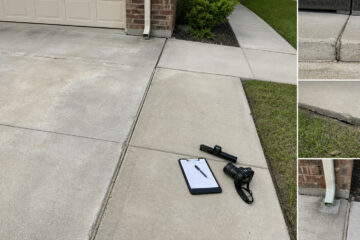
- Document the current condition. Take wide and close photos, include a fixed reference, and date the record.
- Observe water. After ordinary rainfall or irrigation, note where water arrives, crosses the concrete, ponds, and exits.
- Protect the area. Keep normal routes clear and use an appropriate temporary warning if an abrupt change is difficult to see.
- Avoid irreversible DIY work. Do not inject material, cut roots, grind an access route, or rigidly fill a moving joint without a suitable plan.
- Request a site-specific scope. Share your observations and ask why the recommended repair fits the slab’s condition.
Planning for a useful result
The most useful goal is not perfectly new-looking concrete. It is a surface that performs better for its intended use, connects sensibly to adjoining areas, and sheds water as the site allows. Cosmetic cracks or color differences may remain after a functional repair, so expectations should be discussed before work.
Owners should also ask what to monitor after the project. Keep the final scope, photographs, and care instructions. Maintain drains and runoff paths, avoid unapproved fillers, and report unexpected movement. These basic records help distinguish a new issue from a mark that was already present.
For a local evaluation, call 979-272-6536 or request a no-cost quote online. Bryan Concrete Repair And Leveling can review the affected area and discuss an appropriate concrete repair or leveling scope.
Frequently asked questions
What is the first sign that after concrete leveling care Bryan TX may need attention?
Start with a change you can observe: uneven adjoining surfaces, new ponding, a widening opening, rocking concrete, or an awkward walking transition. Document the location and arrange an evaluation if the condition is changing or affects normal use.
Can after concrete leveling care Bryan TX always be repaired without replacement?
No. Some slabs remain sound enough for leveling, joint work, sealing, or a targeted repair, while widespread deterioration or an unsuitable slab may require partial or full replacement. The decision depends on condition and support.
How should a Bryan property owner prepare for a after concrete leveling care Bryan TX evaluation?
Clear the affected area, gather older photos or repair records, identify irrigation and drainage features, and note when the issue is most visible. Do not move heavy slabs or probe around utilities.
Does drainage matter when planning after concrete leveling care Bryan TX in Bryan?
Yes. Roof runoff, grading, drains, irrigation, and ponding can affect support and future performance. The visible concrete and the water path should be reviewed together.
Who should a Bryan owner contact about after concrete leveling care Bryan TX?
Contact a concrete repair professional for an on-site evaluation. You can call Bryan Concrete Repair And Leveling at 979-272-6536 or use the site’s quote form to discuss the surface, access, and observed changes.